
Smart ecosystem for bearded dragons
47% rise
in reptile ownership between 2020 and 2022
10–15
year lifespan impacted by chronic care gaps
Animal-first design
Every feature evaluated first by its impact on the animal's welfare, then by owner convenience, explicitly rejecting the commercial terrarium logic of ease of manufacture.
Informed ownership
Build owner knowledge, not just automated alerts. An owner who understands why their dragon needs UVB is a fundamentally better caretaker.
Gradual enrichment
Environmental complexity introduced over time. Providing a better environment isn't effective if the animal has no experience of what to do with it.
Movable air tubeAir-driven tube repositioned across the tank to create water surface movement, encouraging naturalistic drinking behavior and sensory stimulation.
Cord organizersIntegrated rear-mounted cord management removes cable clutter, reduces safety risks, and makes maintenance easier without additional products.
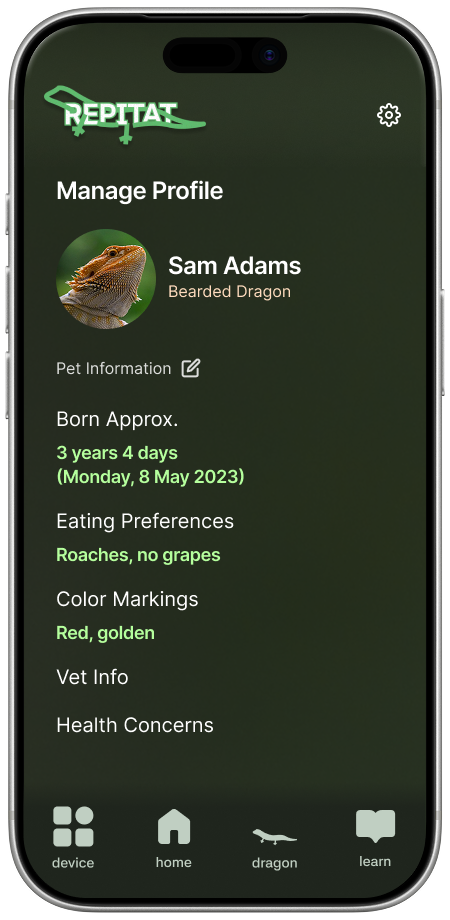
Dragon profileStores age, origin, weight, medical history, and vet notes. Addresses the absence of standardized record-keeping across a 10–15 year lifespan.
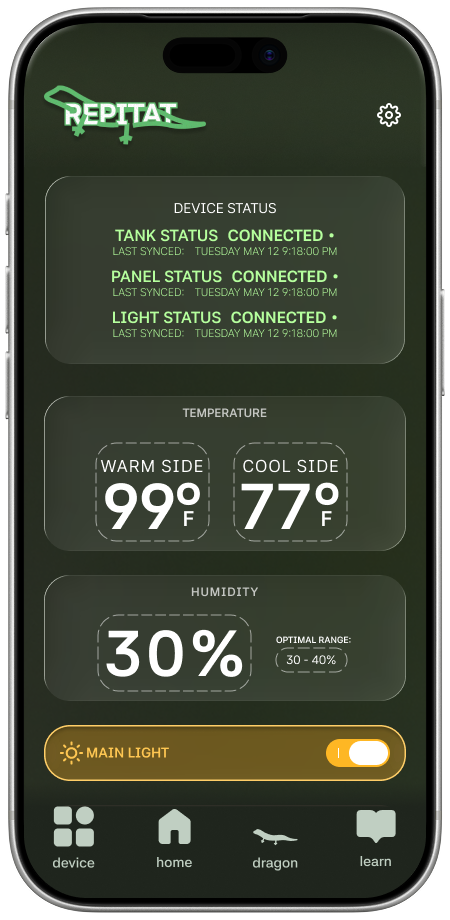
Monitoring dashboardReplicates side panel readings with historical trend data. A basking zone that consistently drops at night becomes visible as a pattern — not just a single bad reading.
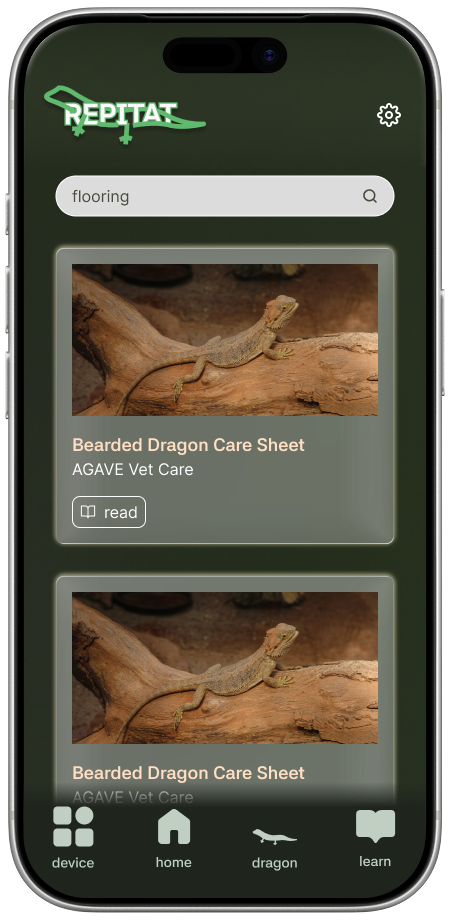
Education sectionCurated, research-grounded guidance on diet, behavior interpretation, and enclosure maintenance. Aimed at reducing the steep learning curve for first-time reptile owners.
What the Project Became Through research and modeling, the project addressed how, when it comes to animal products, animal-first design theory can improve the quality of experiences for both animal and owner alike.
Repitat was an opportunity to explore user experience research and design for a unique and underconsidered user group: animals. This experience allowed me to reconsider what is standard design and how designing for authenticity and empowerment can lead to innovative design systems.